How many kanji do you need for the JLPT?
Start with kana. Then compare how different kanji sets cover the vocabulary in our Japanese word list.
In our Japanese word list, 14.3% of words contain no kanji at all. Learn hiragana and katakana and you can recognise 489 of them before your first kanji. Kana matters most at N5. There, 21.4% of words need no kanji. N4 sits at 17.1%, and at N3 the share falls to 11.2%.
We counted 3,422 words across the word list's N5, N4 and N3 levels, built from 1,428 distinct kanji. Reuse order ranks each kanji by how many words contain it. Textbook order takes the N5 kanji first, then N4, then N3, and ranks by reuse inside each level. At every step we counted how many words use only kanji you already know, with kana counted as known.
How many you need depends on your level. N5 words in this deck use 433 distinct kanji, N4 brings the total to 754, and N3 to 1,428. Learn them by level. Reuse order pulls ahead over the first few hundred kanji, by about twelve points at most. From one thousand and twenty kanji onward, the two orders make exactly the same number of words readable. In our Chinese word list the gap is wider and lasts much longer.
- N560.8%
- N452.6%
- N342.7%
The two orders split, then meet
At three hundred kanji, reuse order makes 1,645 words readable, or 48.1% of the word list. Textbook order makes 1,406, or 41.1%. That is seven points. The same stop in our Chinese word list shows about eleven.
The gap takes a while to open. At one hundred kanji the two orders are less than a point apart, 27.3% against 26.5%.
Reuse order reaches about half the word list at three hundred and twenty kanji, with 50.0%, and passes half at three hundred and forty, with 51.8%. Textbook order gets there at four hundred and sixty, with 51.0%, a hundred and twenty kanji later.
The gap is widest at four hundred and twenty kanji: 57.7% against 45.8%. By five hundred it has narrowed to about eight points, or 2,180 words against 1,900.
Then it closes. At one thousand kanji, the two orders sit at 87.8% and 87.3%, about half a point apart. N3 is close by then too, at 81.1% against 79.7%. From one thousand and twenty kanji they make exactly the same number of words readable, all the way to the full 1,428.
The effect is much smaller than in our Chinese word list, which is why the advice below follows your level. In Japanese, a level-first plan costs some early coverage and nothing after one thousand and twenty kanji.
Textbook order makes every N5 entry readable by four hundred and forty kanji. Reuse order needs nine hundred and sixty.
The kanji doing the most work
日 leads the reuse ranking. It appears in 41 words, from 今日 to 曜日. 人 and 大 tie for second with 34 each, and 物 and 生 follow with 31. 物 alone builds 植物, 食物, 書物 and 人物, and 学 sits in 化学, 進学 and 学者. The ranking falls off quickly. The twenty-fourth kanji, 間, appears in 17 words, fewer than half of 日's count.
These counts use written forms. 日 is one form with several readings: あした in 明日, あさって in 明後日 and いちにち in 一日, so every word still needs its own reading. 生 works the same way in 人生, 芝生 and 生じる, three words with three different readings.
- 日
- ひ sun, day
- にち day (counter reading)
- 明後日あさってthe day after tomorrow
- 明日あしたtomorrow
- 一日いちにちone whole day
- 五日いつかthe fifth day, five days
- 人
- ひと person
- 大人おとなadult
- 外国人がいこくじんforeigner
- 一人ひとりone person, alone
- 二人ふたりtwo people
- 大
- だい big, large (prefix)
- 大きいおおきいbig
- 大きなおおきなbig (before a noun)
- 大勢おおぜいa crowd of people
- 大人おとなadult
- 物
- もの thing, object
- 買い物かいものshopping
- 果物くだものfruit
- 建物たてものbuilding
- 食べ物たべものfood
- 生
- せい life, birth
- なま raw, fresh
- 生まれるうまれるto be born
- 学生がくせいstudent
- 生徒せいとpupil (school student)
- 先生せんせいteacher
- 一
- いち one
- 一日いちにちone whole day
- 一番いちばんnumber one, the most
- 一緒いっしょtogether
- 一昨日おとといthe day before yesterday
- 学
- がく learning, scholarship
- 学生がくせいstudent
- 学校がっこうschool
- 大学だいがくuniversity
- 留学生りゅうがくせいexchange student
- 気
- き spirit, feeling
- 元気げんきhealthy, lively
- 天気てんきweather
- 電気でんきelectricity, electric light
- 病気びょうきillness
- 上
- うえ up, on top
- じょう upper, first volume
- うわ upper, outer layer
- 上げるあげるto raise, to lift up
- 上着うわぎjacket, outer garment
- 上手じょうずskillful, good at
- 屋上おくじょうrooftop
- 行
as in 行く (いく): to go
- 行くいくto go
- 銀行ぎんこうbank
- 飛行機ひこうきairplane
- 旅行りょこうtrip, travel
- 中
- なか inside, middle
- ちゅう middle, during, medium
- 中学校ちゅうがっこうjunior high school
- 中々なかなかquite, not easily
- 背中せなかback (of the body)
- 真ん中まんなかthe middle, center
- 出
- で coming out, attendance
- 出すだすto take out, to submit
- 出かけるでかけるto go out
- 出口でぐちexit
- 出るでるto go out, to leave
- 手
- て hand
- お手洗いおてあらいrestroom
- 切手きってpostage stamp
- 上手じょうずskillful, good at
- 手紙てがみletter (mail)
- 事
- こと matter, thing (abstract)
- 仕事しごとwork, job
- 大事だいじimportant, valuable
- 用事ようじerrand, things to do
- 事務所じむしょoffice
- 会
as in 会う (あう): to meet someone
- 会うあうto meet someone
- 会社かいしゃcompany
- 機会きかいopportunity
- 会議室かいぎしつmeeting room
- 年
- とし year, age
- 去年きょねんlast year
- 今年ことしthis year
- さ来年さらいねんthe year after next
- 毎年まいねんevery year
- 合
as in 合う (あう): to fit, to suit, to match
- 場合ばあいcase, occasion
- 試合しあいmatch, game
- 都合つごうconvenience, circumstances
- 具合ぐあいcondition (health, state)
- 下
- した below, under
- しも lower part, downstream
- げ lower, inferior, last volume
- 下さいくださいplease give me
- 靴下くつしたsocks
- 地下鉄ちかてつsubway
- 下手へたunskilled, bad at
- 分
- ぶ one tenth, percentage
- ぶん part, share, portion
- 自分じぶんoneself
- 多分たぶんprobably
- 半分はんぶんhalf
- 分かるわかるto understand
- 地
- ち ground, land, earth
- 地下鉄ちかてつsubway
- 地図ちずmap
- 地震じしんearthquake
- 地理ちりgeography
- 見
as in 見る (みる): to see, to watch
- 見せるみせるto show
- 見るみるto see, to watch
- 意見いけんopinion
- 見えるみえるto be visible
- 金
- かね money, metal
- きん gold
- お金おかねmoney
- 金曜日きんようびFriday
- お金持ちおかねもちrich person
- 借金しゃっきんdebt
- 間
- あいだ interval, between
- ま space, pause, room
- 時間じかんtime, hours
- 間違えるまちがえるto make a mistake
- 昼間ひるまdaytime
- この間このあいだthe other day
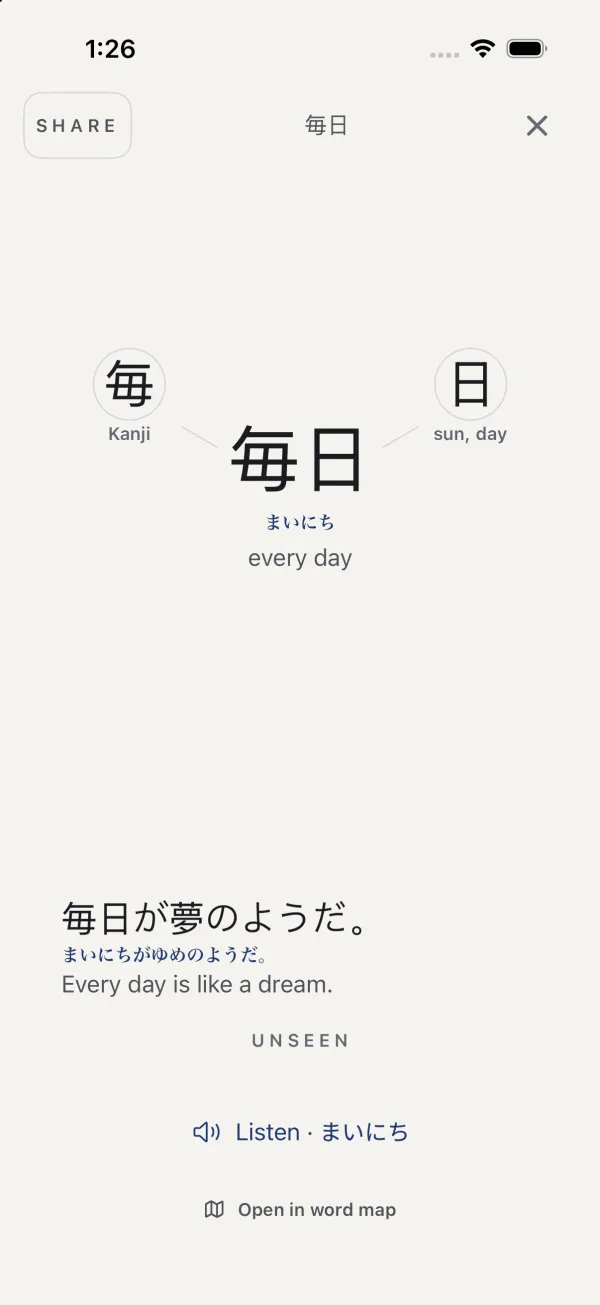
Every word opens like this in Lock In
Kanji, kana and a real sentence, on your lock screen.

Example sentence from Tatoeba, CC BY 2.0 FR.
An entry counts only when you know every kanji in it. Knowing 学 leaves 奨学金 out of reach until 奨 and 金 join it. That makes the count strict. It gives no credit for guessing from context, for alternative kana spellings or for furigana printed above the text.
What this means for how you study
Learn kana first, then the kanji for your target level. Level order pays off fast on the exam you are preparing for. At three hundred kanji, textbook order covers 79.1% of N5 words, against 60.8% for reuse order. N5 words use 433 distinct kanji in this deck, and textbook order makes every N5 entry readable by four hundred and forty kanji. Reuse order does not finish N5 until nine hundred and sixty, more than twice as many.
Reuse order's overall lead comes mostly from N3. N3 supplies 62.2% of the word list's words, so the headline figure follows it closely. Reuse order covers 57.5% of N3 at five hundred kanji, against 41.4% for textbook order. If N3 is a year away, that gap matters less than finishing N5 and N4 now.
N4 shows the other side of the trade. At five hundred kanji, reuse order covers 72.9% of N4 and textbook order 56.1%, because textbook order has only just moved past the N5 kanji. Textbook order finishes N4 at seven hundred and sixty kanji. Reuse order still sits at 97.3% of N4 at one thousand and finishes it at one thousand and twenty, the same stop where the two curves meet.
Use the grid to find the kanji that recur, and learn each one inside a word with that word's reading. The 489 kana-only words need study too. You can read them on day one and still not know what they mean, so test them with the answer hidden.
Two limits apply to every number in this piece. This is the Lock In deck, not the full official list, and it stops at N3, so the totals are not JLPT kanji requirements. And "readable" means you recognise every kanji in an entry. It does not mean you know the word, its reading or its meaning, and it says nothing about listening or reading speed.
The download has the counts at every slider stop and level bar, so you can check any number here. It contains no headwords, readings or example sentences. The method below names the dictionary source behind the word list's words and its licence.
Word play
Some Japanese words are tiny stories. Put two kanji side by side and the meaning almost explains itself. Not every compound works like this, and the reading of the whole word is often a surprise, but the ones that do are easy wins.
A hand on top is a skilled hand. 上手 (じょうず) is the word you hear when someone praises your Japanese, even after one sentence.
Move the hand below and you are bad at it. 下手 (へた) is what you might say back, modestly. Learn the pair together and you already know both sides of the compliment.
Hand plus paper is a letter. Careful if you also study Chinese: there, 手纸 (the same word in simplified characters) means toilet paper.
The feeling people have about you is your popularity. A long queue outside a ramen shop is a sign of 人気.
Tips and tricks
- Start with kana. The 489 kanji-free words are free points. Learn hiragana and katakana and they are yours before your first kanji.
- Pick your goal first. At three hundred kanji, textbook order covers 79.1% of N5. If the exam is close, finish your level before chasing the most reused kanji.
- Expect more than one reading. Tap or hover 日 and compare its example words: one kanji, several readings. Learn each whole word with its own reading.
- Collect word pairs. 上手 and 下手 stick because they come as a pair. When you meet one half of a pair, look up the other.
How we counted
We counted 3,422 entries, one per deck id, with 3,355 distinct headwords. Repeated headwords count once per record. Shares use entry counts as denominators.
A character is a Unicode scalar in U+3400-U+4DBF, U+4E00-U+9FFF or U+F900-U+FAFF. We apply no normalization. 々, kana, Latin and punctuation need no learning in this study.
Most reused first sorts by the number of distinct entries containing each character, descending. Ties use the first level rank, then code point, ascending. Textbook order sorts by first level rank, then reuse count descending, then code point ascending. Level ranks are N5 < N4 < N3.
An entry is readable when you know every counted character in it. Entries without counted characters are readable at zero. This means character recognition, not knowledge of every meaning. Each level share uses that level’s entries as its denominator.
This is the Lock In deck, not the complete official list.
Input file: apps/lockin-chinese/ios/LockInKit/Sources/LockInScriptJa/Resources/ja-sample.json
SHA256: 64f20f2499f6a958da1330b3f4be2a3bdcdf75fe7d2f84270c5764ff97358793
Headwords derive from EDRDG data under CC BY-SA 4.0. Study counts were derived by Lock In. The source data and notices are available at /data. This study uses no example sentences.
The lab assumes you can read kana.
Every word opens like this in Lock In
Kanji, kana and a real sentence, on your lock screen.
Example sentence from Tatoeba, CC BY 2.0 FR.